


It is often hard to determine what is guiding Donald Trump a month into the American and Israeli campaign of military action on Iran.
However, it remains clear he has a keen focus on the oil markets.
A word – or online message – from the American leader about his plans used to spark substantial moves in prices, as traders reacted to indications the conflict could intensify or conclude.
However, in the last week, market players seem to be growing more doubtful about the significance of his remarks.
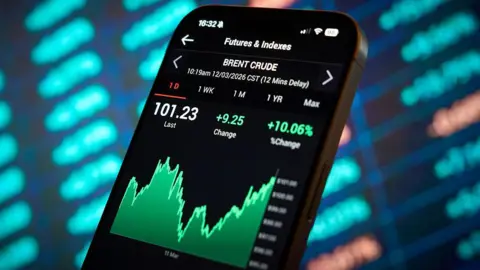
Crude oil was trading at approximately $72 a barrel prior to 28 February, when the military action against Iran began.
Recently, it peaked at $118 a barrel on 19 March and as of Friday afternoon was sitting at around $112 – substantially higher than its pre-war price.
Below are key instances from the last month where Trump and the financial markets seem to have influenced each other – with mixed impacts.
Use the navigation button to move to the next slide.
"Energy prices have come to represent broader political and financial uncertainties, jumping when Trump's rhetoric becomes aggressive and falling back when his language softens," observes one investment manager.
He continues that markets are understandably reactive to those messages, due to the big financial dangers that are associated with increasing oil prices.
"Market participants are trying to evaluate genuine uncertainty," he says. "Markets can look jumpy or confused, but what they're really doing is managing event risk in the moment, with oil positioned directly at the core of that."
However, it can be tough for investors to figure out how to trade, particularly because some of Trump's comments seem aimed at influencing oil prices, instead of conveying policy, says another investment advisor.
"As the saying goes, the initial victim of war is clarity," he observes. "It is likely some of the dialogue trading of statements around successful negotiations, and the opposite, very much are centred around merely influencing the market price of oil."
Investor Response Grow More Subdued
On Thursday, moments after US equity markets experienced their biggest drop since the beginning of the conflict with Iran, Trump said negotiations with Iran were going "very well" and he was postponing planned attacks on Iran's energy infrastructure until at least 6 April.
But, the oil price continued to rise.
One head of FX strategy points out that market reactions are "growing increasingly subdued" because of the "significant disconnect" between Trump's optimistic statements and the lack of response from Tehran.
"Given the optics, many market watchers cannot envision an early end to the conflict and markets continue to be apprehensive."
Another market expert comments investors have also adapted to Trump "frequently shifting position at hints of geopolitical, equity market or market turmoil".
"We are seeing a amount of scepticism, or even frank suspicion, emerging at the fringes," he adds.


